
Wind energy stands as a prominent renewable energy source, holding immense potential for a sustainable future. While horizontal axis wind turbines (HAWTs) dominate the landscape, another contender, the vertical axis wind turbine, offers a distinct set of advantages. Let’s delve into the world of VAWTs, examining their design, operation, benefits, and the role they could play in reshaping how we generate power.
Understanding Vertical Axis Wind Turbines
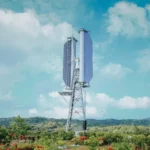
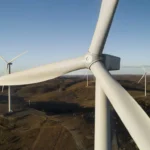
Unlike HAWTs, which resemble airplane propellers and must face the wind, vertical axis small scale wind turbines, or vawts, feature a rotor that spins around a vertical axis. Imagine a giant eggbeater or a revolving door, and you’ll have a good mental image. This fundamental difference in design leads to several key distinctions in how they function and where they can be deployed.
Two primary types of VAWTs exist the Darrieus and the Savonius. Darrieus turbines boast a higher efficiency, employing curved blades that resemble an eggbeater. They operate on the principle of lift, similar to an airplane wing. Savonius turbines, on the other hand, utilize a drag-based design, with scooped blades that catch the wind. While less efficient than Darrieus turbines, Savonius turbines offer a simpler construction and can start rotating at lower wind speeds.
So, why aren’t VAWTs as ubiquitous as their horizontal counterparts? To understand that, we need to weigh the pros and cons.
Advantages of Vertical Axis Wind Turbines
VAWTs present a compelling set of benefits that make them attractive for specific applications. First and foremost, their omnidirectional nature means they don’t need to be pointed into the wind. This simplifies their design and reduces the complexity of control systems. Imagine the savings in maintenance and the improved reliability that comes from eliminating the need for yaw mechanisms!
Another significant advantage lies in their ability to operate in turbulent wind conditions. HAWTs struggle in gusty environments, but VAWTs can handle fluctuating wind directions with greater ease. This makes them suitable for urban areas or locations with complex terrain.
Furthermore, VAWTs can be placed closer together than HAWTs. Because they don’t need to face the wind, the spacing requirements are less stringent. This allows for denser wind farms, potentially maximizing power generation in a limited area.
Finally, VAWTs generally operate at lower speeds than HAWTs, reducing the risk of bird strikes and minimizing noise pollution. This makes them more environmentally friendly and potentially more acceptable to communities living nearby.
Challenges and Limitations
Despite their advantages, VAWTs also face certain challenges that have hindered their widespread adoption. One major hurdle is their lower efficiency compared to HAWTs, especially for larger-scale power generation. While Darrieus turbines can achieve reasonable efficiencies, they still lag behind the performance of modern HAWTs.
Another challenge stems from the complex aerodynamic forces acting on the blades. These forces can lead to fatigue and structural issues, requiring robust and often costly designs. The blades of a VAWT experience constantly changing angles of attack, making them susceptible to vibrations and stress.
Additionally, the starting torque of some VAWT designs can be low, requiring external assistance to initiate rotation. This is particularly true for Darrieus turbines. While Savonius turbines generally self-start, their lower efficiency limits their overall power output.
Applications and the Future of VAWTs
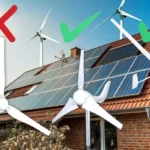
Despite these limitations, VAWTs hold significant promise for specific applications. Their ability to operate in turbulent conditions and their smaller size make them ideal for urban environments, where they can be integrated into buildings or deployed in rooftop installations. Imagine a future where VAWTs adorn skyscrapers, silently generating clean energy for the city below.
Small-scale VAWTs can also provide a reliable source of power for remote locations, off-grid homes, or even portable applications. Their ease of installation and low maintenance requirements make them attractive for areas where access to the electricity grid is limited.
Ongoing research and development efforts are focused on improving the efficiency, reliability, and cost-effectiveness of VAWTs. Innovations in blade design, materials science, and control systems are paving the way for more advanced VAWT technologies. Perhaps in the near future, we will see a resurgence in the use of vertical axis machines, as the world seeks creative, sustainable solutions for energy.
What role will vertical axis machines play in the future of energy generation? Only time will tell, but their unique characteristics suggest they will find a niche in our ever-evolving energy landscape. As technology advances and costs decline, VAWTs could become an increasingly important part of our renewable energy mix, helping us to create a cleaner and more sustainable future for all.